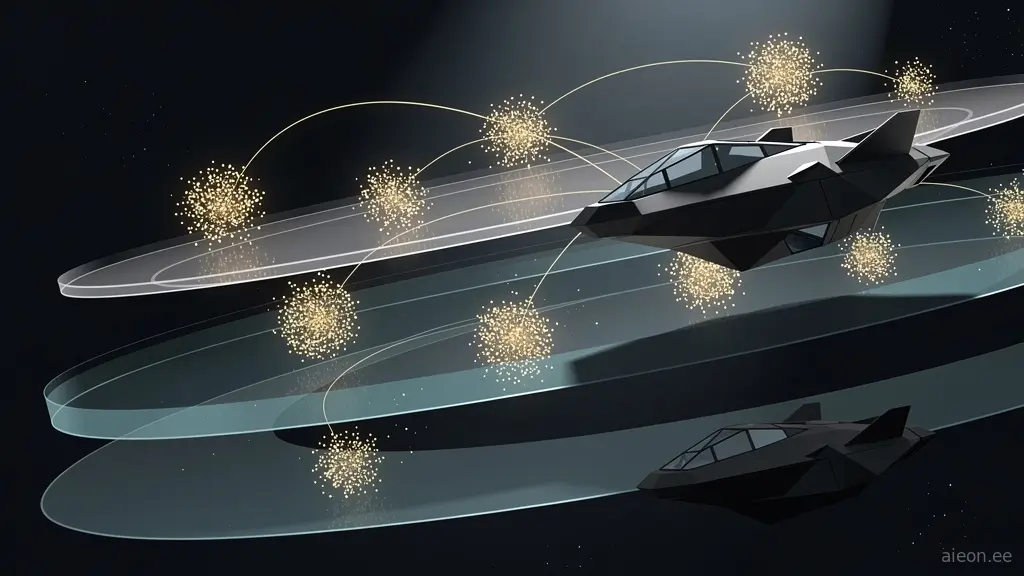
NASA Tests GPS-Free Satellite Navigation Using Orbital Landmarks
NASA’s Starling mission has demonstrated FALCON, a system that lets satellites determine their orbits without GPS by treating other spacecraft and debris as optical landmarks. Over three days the payload improved cataloged orbits for more than 200 objects entirely onboard, using star-tracker cameras and an onboard catalog. The result marks a first for autonomous optical relative navigation in orbit.
Near-Earth satellites normally depend on GPS, but signals weaken or vanish at the Moon and beyond. FALCON, developed with Stanford spin-out EraDrive, matches camera detections against a public space-object catalog, then solves for the host satellite’s position while refining the tracked objects’ orbits. Later tests will let Starling’s four craft share observations for collective refinement.
The approach reduces reliance on ground tracking and supports collision avoidance and distributed science. Uncertainties remain around performance in denser debris fields, long-term catalog drift, and scaling to lunar or deep-space swarms where absolute references are scarcer. Precision gains must still be validated against independent ranging.
Sources: ScienceDaily, NASA.
Roman Space Telescope Encapsulated Ahead of Launch
NASA has sealed the Nancy Grace Roman Space Telescope inside its Falcon Heavy fairing at Kennedy Space Center, clearing a major pre-launch milestone. Liftoff is targeted no earlier than 30 August 2026 toward Sun-Earth L2. Once operational, the observatory is expected to discover thousands of exoplanets while mapping dark matter and dark energy across wide sky surveys.
Roman’s wide-field infrared design will census planetary systems and track large-scale structure to probe cosmic acceleration. Encapsulation protects the optics during ascent; fairing separation occurs minutes after launch. The mission builds on earlier concepts for a Hubble-class surveyor optimized for statistical cosmology and microlensing planet detection.
Schedule risk and on-orbit commissioning remain. Dark-energy constraints will depend on systematic control of weak-lensing and supernova measurements; exoplanet yields hinge on microlensing cadence and crowding. Success would deliver population statistics far beyond current samples, but interpretation of acceleration drivers still faces model degeneracies.
Sources: ScienceDaily, NASA.
Phonons Protect and Carry Quantum Information on Chip
Harvard SEAS researchers have shown that continuous mechanical driving with phonons can both transmit and shield quantum information stored in a silicon-vacancy spin in diamond. By dressing the spin with an acoustic field inside a phononic cavity, they extended coherence roughly threefold while remaining compatible with the same structures used for phonon-mediated coupling. The work appears in Nature Physics.
Phonons offer shorter wavelengths than photons at equivalent frequencies, enabling denser chip-scale networks, and couple readily to both spins and electromagnetic fields. Conventional microwave decoupling fails inside phononic cavities; the all-mechanical continuous drive sidesteps that limit. The dual role—carrier plus protector—simplifies hybrid quantum architectures.
Coherence gains are still modest relative to the times needed for complex algorithms or long-distance links. Scaling to multi-node networks, phonon loss, and integration with other qubit types remain open. The method demonstrates principle but must prove robustness under realistic noise and fabrication variation.
Sources: Phys.org, Nature Physics.