Analysis: Science & Technology — 16 November 2026
Delft physicists flip a single atom’s nuclear spin with radio waves
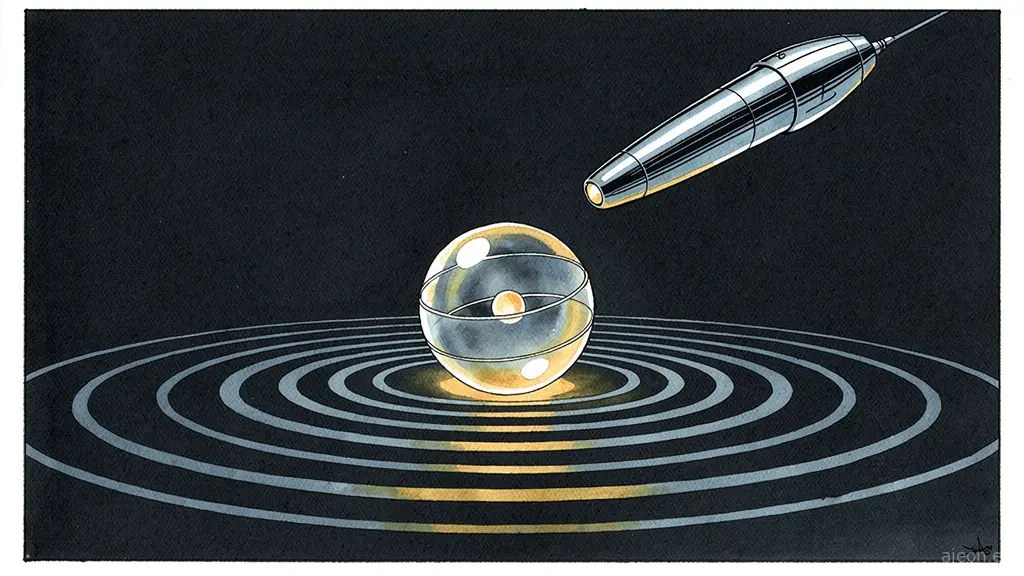
Researchers at Delft University of Technology report that radio-frequency signals delivered through a scanning tunneling microscope can reverse the nuclear magnetic spin of a single atom. The result, published in Nature Communications and led by Hester Vennema and Sander Otte, was obtained even when the electron and nuclear spins were largely disentangled. That outcome stands out because, on the team’s own account, a nucleus should not respond to the microscope’s electrical signals under a simple picture of atomic magnetism.
Electron spin supplies most of an atom’s magnetism and is easier to detect. Nuclear spin is weaker but better shielded from the environment, which is why it is a candidate for quantum memory. Until now the Delft group had read nuclear spin only indirectly, through the hyperfine coupling that slightly entangles it with the electron. The new experiment adapted double magnetic resonance to one atom, applying two frequencies at once: nuclear “notes” sit a hundred to a thousand times lower than those of the electron.
The practical claim is limited. Direct nuclear control could, in principle, help write and read quantum information that lasts longer than electron-based states. The researchers do not yet have a working memory device, and they do not know the coupling that lets the electrical probe move the nucleus. The finding is therefore both a hardware step and an open theoretical problem.
Penn stacks Mylar into crush-resistant lunar insulation
Engineers at the University of Pennsylvania have built hybrid layered insulating film stacks (HyLIFS) from hundreds of ultrathin Mylar (BoPET) sheets, some coated with alumina. In vacuum tests reported in ACS Applied Materials & Interfaces, the stacks combined thermal conductivity comparable to advanced vacuum insulation with the ability to bend and to survive compression of about 20 megapascals—roughly 200 pounds on a fingertip—ten times in a row. The work targets lunar habitats, where temperatures swing from cryogenic to boiling and materials must survive packing, launch, and accidental impacts.
Standard space multilayer insulation reflects radiation well but tears easily; aerogels insulate but crush. Strengthening either usually lets more heat through. The Penn stacks keep commercial “antiblocking” particles that prevent films from sticking. Models and measurements indicate that, in vacuum, much of the heat between layers travels through those particle contact points, so thinner film is not automatically better.
The samples are about one square centimeter and are stacked by hand with tweezers. Scale-up, coating of meter-scale rolls, and tests of scratches, repeated flexing, and habitat-scale pressure remain undone. If those hold, the same architecture could insulate suits, rovers, and electronics as well as walls.
Ice-giant models recast Uranus and Neptune’s tilted magnetic fields
New interior simulations from the University of Texas at Austin Jackson School of Geosciences address the off-axis magnetic fields Voyager 2 measured at Uranus and Neptune in the 1980s. Earth’s magnetic dipole is tilted by about 11 degrees; Uranus’s is about 59 degrees and Neptune’s about 47. The models treat the ice giants’ deep interiors as regions where extreme pressure and temperature break water into ions, so electrical conductivity rises with depth rather than forming an Earth-like convective core dynamo.
That conductivity gradient can sustain a dynamo whose magnetic axis is both offset and unstable. In some runs the tilt changes by tens of degrees within a few decades, versus about one degree in 50 years for Earth. Analysis of that result is that the fields recorded by Voyager 2 may already be outdated, which would make a single flyby a poor snapshot of a time-varying system.
The simulations are not in situ data. They do not fix the planets’ bulk composition, and they have not been checked against a second spacecraft. A dedicated ice-giant orbiter would be needed to test whether the magnetic axes have moved since the 1980s.
Sources: ScienceDaily, ScienceDaily, ScienceDaily.