Analysis: Science & Technology — 02 November 2026
IBM links two 120-qubit processors with four superconducting cables
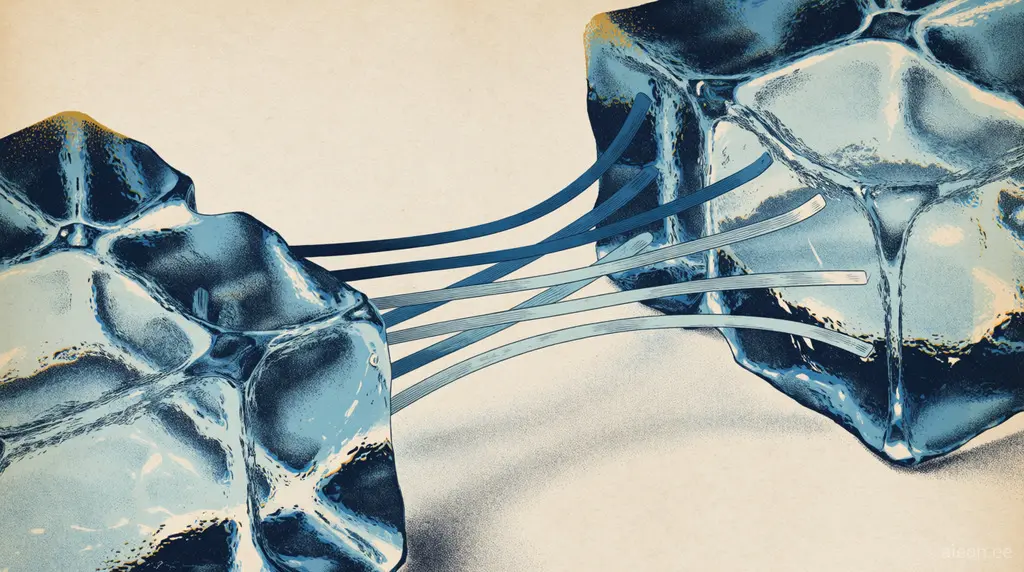
IBM Research has joined two 120-qubit Nighthawk R1 superconducting processors with four separate quantum links, each an 80-centimeter aluminum cable installed after both chips were already mounted in a cryostat. Across the links, quantum states transferred with an average accuracy of 99 percent, peaking at 99.29 percent on the best channel, while two-qubit logic spanning both chips averaged 94.75 percent. The team generated 4- and 6-qubit entangled states shared across the pair and ran two entangled pairs at once on neighboring cables; all four links survived three warm-up and cool-down cycles. The result, posted on arXiv, is the first reported meter-scale, multi-cable interconnect between large superconducting processors.
Modular architectures are widely treated as the practical path to bigger machines, because a single chip cannot host unlimited qubits. Earlier superconducting links were typically a single connection between small experimental devices. IBM’s design uses interface qubits, adjustable couplers, and vertical cable plugs so several links can sit close together at temperatures just above absolute zero.
The open question is whether the hardware is ready to scale. Cross-chip two-qubit fidelity still trails typical on-chip gates, and the authors note that quantum-information lifetime must improve before the scheme is commercially useful. The paper is a preprint, so independent replication and peer review remain outstanding. Analysis: the engineering advance is real—post-install, multi-cable, thermal-cycle-tolerant links—but it does not yet close the gap between a two-module testbed and a maintainable multi-processor computer.
Hubble and Webb find 27 trans-Neptunian objects that preserve formation colors
NASA’s Hubble and James Webb telescopes, observing the same sky in visible and infrared light, have identified 27 previously unknown trans-Neptunian objects, the smallest about 5 kilometers across. Two studies in The Astronomical Journal report that even these faint bodies keep the same color–composition patterns as much larger TNOs, and that “cold” and “hot” populations have similar size distributions despite different orbital histories. Webb also found fewer very small objects than some planet-formation models predict.
TNOs are leftover planetesimals from the solar system’s first growth stage. Cold objects still occupy near-circular orbits near the ecliptic; hot objects formed closer in, then were scattered as Uranus and Neptune migrated. Colors act as chemical fingerprints of those birth regions.
The tension is physical, not merely statistical. Collisions over billions of years were expected to strip or remix surfaces and change the colors of the smallest bodies; that shift is not seen. Either impacts were rarer than assumed, or surfaces somehow retain original composition after fragmentation. Analysis: the data weaken simple collisional-reset models and imply that planetesimal size-sorting was similar in both hot and cold disk regions, but they do not yet identify the missing small-body population or the surface process that “remembers” formation.
Electrically driven molecular Archimedes screw boosts conductance 100-fold
A spiral molecule suspended between atomically sharp gold electrodes rotates when current flows and reverses when voltage polarity is flipped—the first electrically driven molecular motor that is wired to two metal contacts and steered in both directions. Quantum simulations show that rotation raises electrical conductance by as much as 100 times, because motion reaches geometries the resting molecule avoids. The work, in Nature, unites synthesis in Copenhagen, single-molecule measurements at the Weizmann Institute, and theory at the University of Augsburg.
Earlier electric molecular motors (from 2011) sat on surfaces and needed a scanning-tunneling-microscope tip. The new device copies the Archimedes screw: electrons traversing the helix transfer angular momentum, producing continuous spin above a voltage threshold.
The setup remains a single-molecule laboratory contact, not a circuit component. Proposed uses in molecular electronics, spintronics, or microfluidics are extrapolations. Analysis: the coupled electromechanical effect is the scientific core—current makes rotation, rotation remakes current—while durability, integration, and whether the 100-fold gain survives outside a gold nanogap are untested.
Sources: Phys.org; arXiv:2610.29986; ScienceDaily; NASA; The Astronomical Journal; University of Augsburg; Nature.