Evidence of Quantum Vacuum Birefringence from a Magnetar
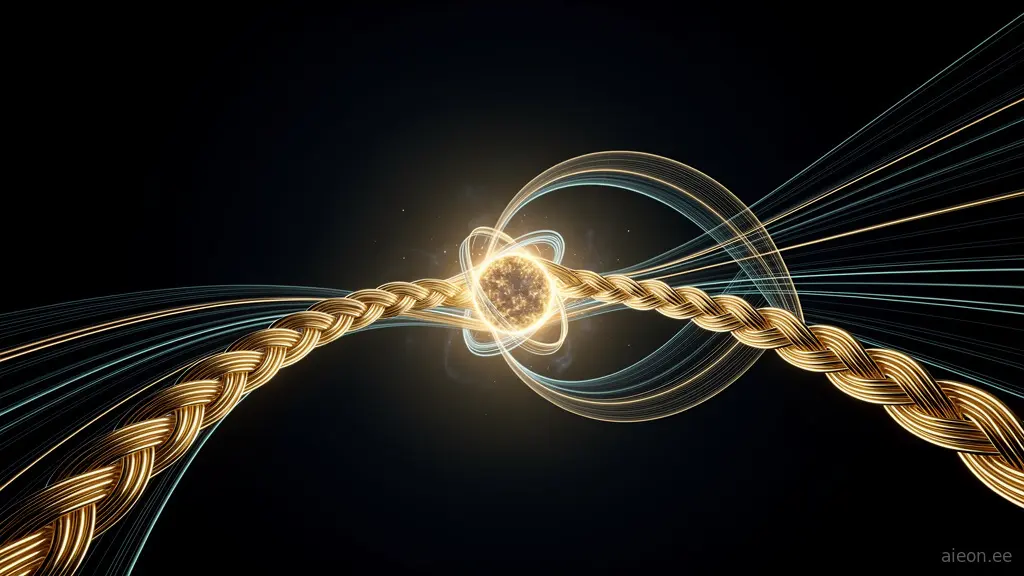
Astronomers using NASA’s IXPE X-ray polarimeter, supported by radio data from CSIRO’s Parkes telescope, report strong polarization signatures from the magnetar 1E 1547.0-5408 that match predictions of vacuum birefringence. The effect, first outlined by Heisenberg nearly 90 years ago, arises when an extreme magnetic field aligns virtual particles in the quantum vacuum, altering the polarization of light passing through “empty” space. High polarization degrees (up to 80 percent) and coherent swings locked to the magnetar’s magnetic axis provide the clearest observational candidate yet for this quantum-electrodynamic process.
Magnetars possess fields trillions of times stronger than Earth’s, far beyond laboratory reach, making them natural laboratories for quantum vacuum effects. Earlier claims were inconclusive because of uncertain geometry and competing emission processes. The near pole-on view and aligned magnetic-rotational axes of this source remove key ambiguities, allowing the polarization pattern to be tracked across the 2.1-second rotation period.
Confirmation still requires additional multi-wavelength data and refined simulations to rule out conventional plasma or surface effects. If verified, the result would constitute the first direct detection of vacuum birefringence and open a new observational window on quantum electrodynamics under extreme conditions.
Sources: ScienceDaily, Swinburne University of Technology, Nature.
Light-Powered Nanorobots That Collect and Relocate Bacteria
Researchers at the University of Würzburg have demonstrated sub-micrometer robots propelled and steered solely by light that can hunt, gather, and deposit bacteria at chosen locations in liquid. The devices, smaller than one micrometer, use plasmonic nanoantennas that absorb polarized light and generate photon-recoil thrust; polarization direction orients the robots while recoil provides forward motion. They execute rapid 90-degree turns, remain maneuverable while carrying bacterial loads, and function as microscopic cleaners under laboratory conditions.
Precise manipulation of individual microbes and cells has long been limited by the lack of controllable actuators at that scale. Earlier light-driven microdrones were larger; the new design simplifies the antenna architecture and shrinks the platform into the microbial size regime while retaining independent propulsion and steering. The work appears in Nature Communications.
Speed decreases under heavy loads, and operation remains confined to controlled optical environments. Scaling to complex biological media, selective targeting of specific species, and integration with sensing remain open engineering challenges before practical microbiological or biomedical use.
Sources: ScienceDaily, University of Würzburg, Nature Communications.
Physics-Informed AI Reconstructs Hidden Mantle Convection History
A University of Tsukuba researcher has developed a physics-informed neural network that recovers past temperature fields and deep mantle flow from only near-surface motion data and a present-day temperature snapshot. Trained to satisfy the governing equations of heat transport and viscous flow as well as fit synthetic observations, the model accurately reconstructed two-dimensional thermal convection histories that were never directly supplied. The approach is reported in the Journal of Geophysical Research: Machine Learning and Computation.
Mantle circulation drives plate tectonics yet remains largely inaccessible; conventional methods rely on incomplete surface geology and seismic tomography. By embedding physical constraints directly into the network, the inverse problem becomes tractable even with sparse data. Tests on simulated convection demonstrate that complementary surface and present-day constraints are essential for unique recovery.
Extension to three-dimensional, realistic Earth models and noisy observational datasets is still required. Uncertainties in rheology, composition, and boundary conditions will propagate into reconstructed histories, and validation against independent geological records remains necessary.
Sources: Phys.org, University of Tsukuba, Journal of Geophysical Research: Machine Learning and Computation.