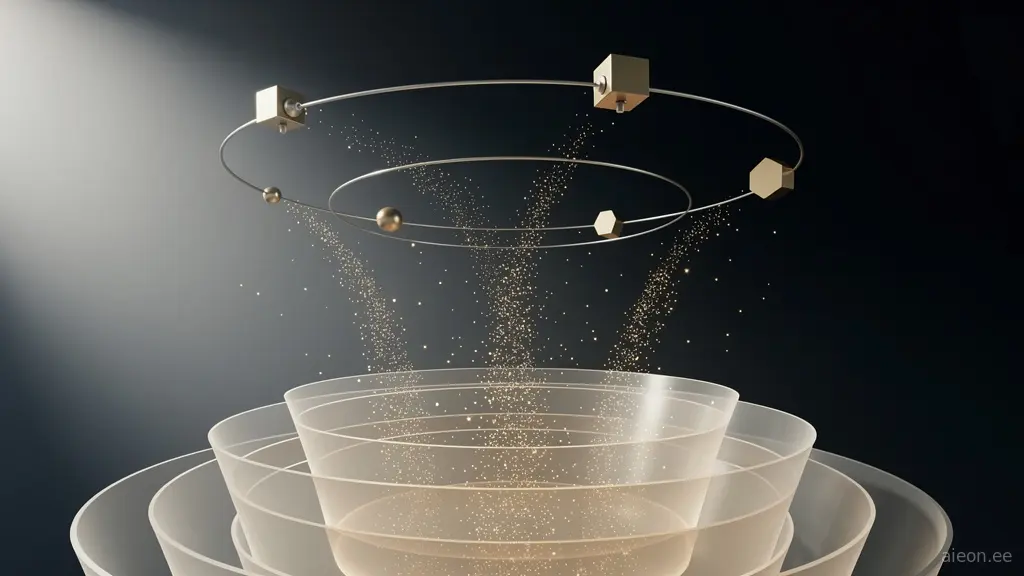
Geoneutrinos Map Earth’s Mantle Radioactivity
A global network of neutrino detectors, including the recent SNO+ results from Canada, is delivering the first multi-hemisphere measurements of geoneutrinos produced by radioactive decay deep in Earth’s mantle. Published coverage on August 7 highlights how these ghostly particles offer a direct chemical probe of the heat engine driving plate tectonics and the magnetic field. The data stand out because SNO+ provides the first western-hemisphere view, complementing earlier KamLAND (Japan) and Borexino (Italy) detections and hinting at possible non-uniform distribution of uranium and thorium.
Geoneutrinos arise from the decay of uranium, thorium and potassium that supply a substantial fraction of Earth’s internal heat. Detectors buried kilometers underground use large volumes of liquid scintillator to catch the rare interactions. Conventional geochemistry assumes thorough mixing in the convecting mantle, yet flux differences between sites align roughly with large low-shear-velocity provinces (LLSVPs) under Africa and the Pacific.
Major uncertainties remain in subtracting crustal contributions, reactor backgrounds and detector systematics; the apparent hemispheric differences could still be artifacts. Upcoming JUNO data from China and proposals for ocean-bottom detectors aim to reduce these errors and test whether radioactive elements concentrate in deep mantle structures.
Sources: Quanta Magazine, arXiv.
XENONnT Sets Tightest Limits on Light Dark Matter
The XENON collaboration released a blind analysis of 7.8 tonne-years of ionization-only data from the XENONnT detector at Gran Sasso, establishing the most sensitive constraints yet on axion-like particles and dark photons. The August 7 results push past previous bounds and approach the irreducible solar-neutrino fog that will eventually limit all such searches. No excess signal was found, narrowing the parameter space for several leading light dark-matter candidates.
XENONnT uses nearly 6 tonnes of liquid xenon to look for faint energy deposits from particle absorption by electrons rather than nuclear recoils. Machine-learning models of electronic backgrounds were finalized before unblinding to avoid bias. Earlier WIMP searches have repeatedly come up empty, shifting focus to lighter, more weakly interacting particles.
The experiment has now reached the sensitivity edge where solar neutrinos become an irreducible background. A planned six-times-larger successor will require still more sophisticated analysis techniques; whether any of the remaining parameter space harbors dark matter remains open.
Sources: Phys.org, Physical Review Letters.
Room-Temperature Phonon Focusing Guides Heat Like Light
UCLA researchers demonstrated that heat can propagate as focused, ray-like phonon beams through boron arsenide crystals at room temperature rather than diffusing isotropically. The August 7 Nature Physics report shows nanoscale temperature maps revealing crystal-orientation-dependent focusing patterns (four-, six- and eight-fold). The effect, previously seen only at cryogenic temperatures, opens routes to directional thermal management in electronics and quantum devices.
Phonons—quantized lattice vibrations—normally scatter rapidly at ambient conditions, erasing wave-like transport. Boron arsenide’s unusually weak phonon scattering allows coherent focusing over micrometer scales, analogous to optical waveguiding. The team’s earlier work established the material’s record thermal conductivity.
Practical device integration and scaling beyond laboratory crystals remain unproven; scattering from defects or interfaces could destroy the effect in real chips. Whether the technique can be engineered into commercial semiconductors or quantum hardware is the next uncertainty.
Sources: ScienceDaily, Nature Physics.